Rankings
Best Crypto Cards in 2026: Top 10 Crypto Cards Compared
Published on:
Crypto cards are no longer just exchange debit cards that convert Bitcoin into fiat at checkout.
In 2026, the category includes self-custody cards, stablecoin-first cards, crypto-backed credit products, exchange-linked debit cards and global spending accounts with rewards that can reach several percent.
That makes choosing one harder.
The card advertising the highest cashback is not necessarily the card that gives you the most value. A 10% headline rate can require high monthly spending, a large crypto balance or a specific membership tier. Meanwhile, a card offering only 1–3% may be considerably cheaper once FX fees, conversion costs, subscriptions and reward caps are included.
For this ranking, ChainLeads compared leading crypto cards based on real spending cost, realistically obtainable rewards, geographic availability, custody model, funding flexibility and everyday usability.
Our best overall crypto card for 2026 is ether.fi Cash. Kraken Card is our preferred low-fee option for eligible European and UK users, while MetaMask Card is our top choice for users who want to retain self-custody until payment.
Card availability, fees and rewards can change quickly. Always verify current terms with the provider before applying.
Best Crypto Cards in 2026 — Quick Picks
Best Overall: ether.fi Cash
Best for Low Fees: Kraken Card
Best for Self-Custody: MetaMask Card
Best for Travel: Wirex One
Best for Stablecoins & Global Spending: KAST
Best for Active Traders: Bybit Card
Best for Spending Without Selling Crypto: Nexo Card
Best for Established Ecosystem Perks: Crypto.com Prepaid Card
Best DeFi-Native Stablecoin Card: Gnosis Pay
Best Crypto Cards Compared
Rank | Crypto Card | Best For | Card Model | Realistic Rewards | Maximum Advertised | Score |
|---|---|---|---|---|---|---|
1 | Overall value | Crypto-native credit / Direct Pay | 3% on first Core spending band | 3% standard cashback tier | 9.2/10 | |
2 | Low-fee spending | Debit | 0–1% for lower balance tiers | 2% | 9.0/10 | |
3 | Self-custody | Wallet-linked debit | 1% Virtual | 3% Metal | 8.9/10 | |
4 | Travel | Crypto-enabled debit | From 0.5% | 8% | 8.7/10 | |
5 | Stablecoins / global use | Stablecoin-linked card | Depends on current tier | Up to 6% | 8.6/10 | |
6 | Traders | Exchange-linked debit | 2%, subject to tier limits | 10% | 8.5/10 | |
7 | Crypto-backed spending | Debit + credit modes | 0.5% NEXO at Base eligible tier | 2% NEXO | 8.3/10 | |
8 | Ecosystem perks | Prepaid / regional card program | 0–2.5% on lower plans | 4.5% | 8.2/10 | |
9 | Self-custody / Europe | Wallet-linked debit | 1% base | Up to 20% in selected categories | 8.1/10 | |
10 | Onchain stablecoins | Self-custody-linked debit | No permanent fixed cashback currently used in our score | Program-dependent | 8.0/10 |
Want your crypto card to be considered for the next update of this ranking?
Write to us by email or submit your card for review — we regularly update this list and carefully evaluate new products.
Important: maximum advertised cashback and realistic cashback are not the same thing.
For example, Kraken’s 2% tier requires a €50,000/£50,000 average balance, while Bybit’s highest rates require significantly higher spending or account status.
How We Ranked the Best Crypto Cards
We ranked each card using a 100-point methodology focused on real-world value rather than headline cashback rates.
Factor | Weight | What We Evaluated |
|---|---|---|
Fees & Real Spending Cost | 20% | Card fees, crypto conversion, FX, ATM and other spending costs |
Rewards & Real Value | 15% | Realistic cashback, maximum rates, caps and qualification requirements |
Availability & Eligibility | 15% | Supported countries, residency requirements and accessibility |
Funding & Spending Flexibility | 15% | Supported crypto, stablecoins, fiat balances and spending options |
Custody & Provider Trust | 15% | Self-custody vs custodial models, transparency and provider track record |
Everyday Usability | 10% | Visa/Mastercard, physical and virtual cards, Apple Pay, Google Pay and ATM access |
Transparency & Support | 5% | Clarity of fees, rewards and product terms |
Additional Benefits | 5% | Travel perks, subscriptions, insurance and other useful features |
1. ether.fi Cash — Best Overall Crypto Card in 2026
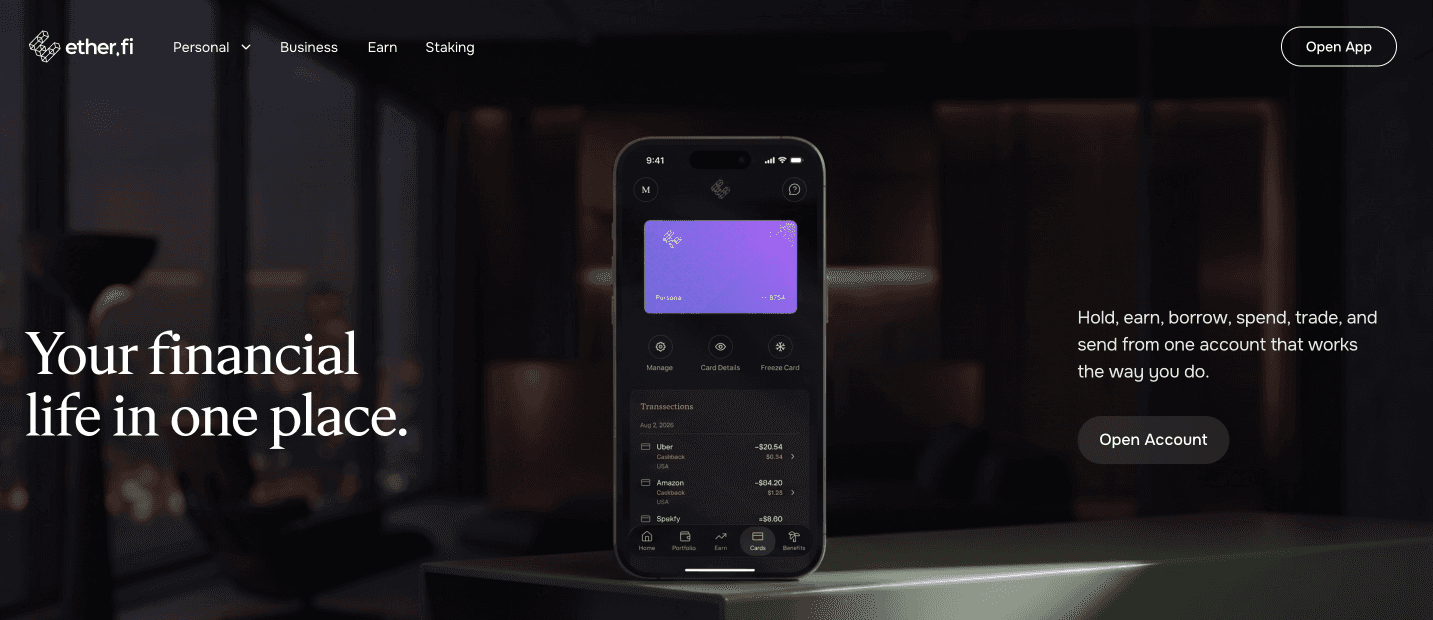
Best for: Overall crypto-native spending
Card model: Crypto-native credit card with Direct Pay and Borrow modes
Network: Visa
Rewards: 3% on the first Core monthly spending band
Availability: Broad international coverage
ether.fi Cash takes our #1 position because it combines three things that rarely appear together: strong realistically obtainable rewards, broad geographic availability and a non-custodial account architecture.
Users can operate the card in two different ways.
With Direct Pay, supported assets are spent directly from the user’s Cash account without creating a loan.
With Borrow Mode, purchases borrow against collateral, allowing users to spend without automatically selling their underlying crypto holdings. Interest begins immediately on borrowed balances, so the two modes have very different economics.
ether.fi Cash Rewards
The current Core cashback ladder is unusually competitive.
For standard USD-denominated spending:
first $2,000 per month — 3%;
$2,001–$3,000 — 1%;
above $3,000 — 0.5%.
For EUR transactions, the thresholds differ, with the initial €800 monthly band currently earning 3%.
Cashback is paid in ETHFI after eligible transactions clear and complete the program’s lock period.
That means an eligible user spending $1,000 in the first standard Core spending band can earn approximately:
$30 equivalent in rewards.
That is more useful for comparison purposes than simply advertising an unattainable “up to 10%” rate.
Fees and Card Costs
Core users receive access to a virtual card, although exact issuance costs can differ by jurisdiction.
ether.fi currently lists a $10 standard virtual card fee and $50 physical Core card fee, with some regions or memberships receiving different treatment.
Foreign-currency transactions can also involve an underlying FX base rate plus an additional tier-dependent margin, making the card less attractive for some international currency conversions than its cashback alone might suggest.
Availability
This is one of ether.fi’s biggest strengths.
Its published availability list covers a wide selection of countries across Europe, Latin America, Asia, the Middle East, North America and other regions, although physical-card availability differs by jurisdiction.
Why We Ranked ether.fi #1
ether.fi does not have the simplest card in the ranking.
What it does have is one of the strongest combinations of:
3% accessible initial cashback;
broad international availability;
Direct Pay;
crypto-backed borrowing;
non-custodial account design;
Apple Pay and Google Pay;
physical and virtual card options.
Its complexity is the price users pay for that flexibility.
Pros
3% cashback on the initial Core monthly spending band
Broad geographic availability
Direct Pay and Borrow modes
Non-custodial account structure
Apple Pay and Google Pay
Visa network
Physical and virtual options
Cons
More complicated than a standard debit card
FX costs can matter
Cashback is paid in ETHFI
Borrow Mode creates interest and liquidation considerations
Card issuance fees can vary by region
Best choice for: Crypto-native users who want a strong mix of rewards, global availability and onchain financial flexibility.
2. Kraken Card — Best Crypto Card for Low Fees
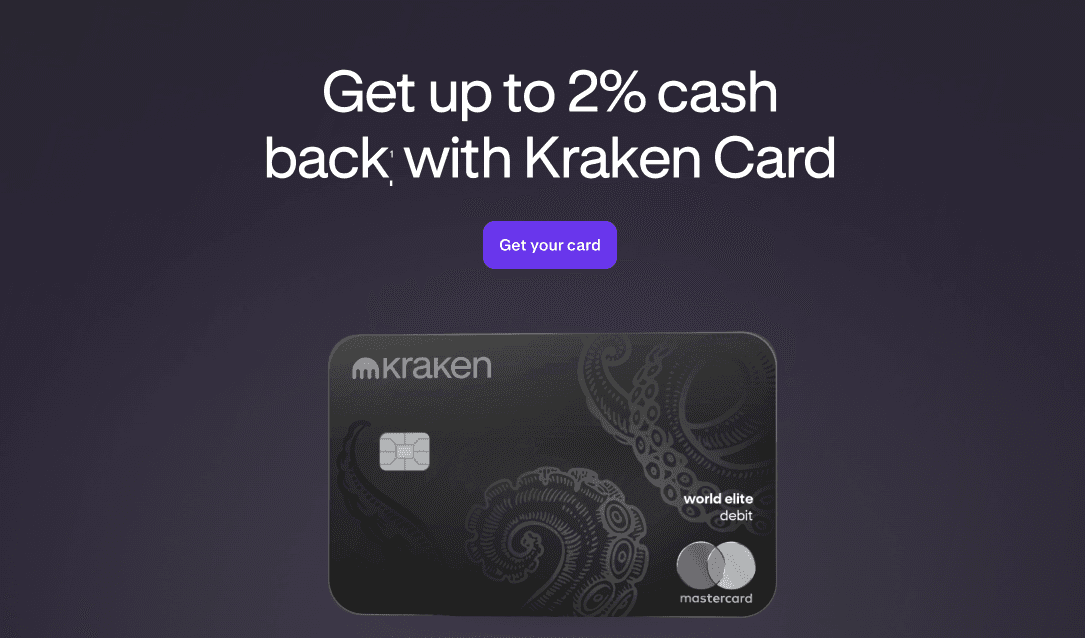
Best for: Simple everyday crypto spending
Type: Mastercard debit card
Availability: UK and EEA
Rewards: Up to 2%
Kraken launched its current Kraken Card for eligible UK and EEA users in July 2026.
It allows cardholders to spend from more than 600 crypto and cash currencies through a Mastercard debit card and currently advertises no Kraken transaction fees, ATM fees or card-level FX fees.
That simplicity is the main reason Kraken ranks second.
Kraken Cashback
The rewards structure is unusually transparent:
Average 30-Day Balance | Cashback |
|---|---|
€0 / £0 | 0% |
€200 / £200 | 0.5% |
€1,000 / £1,000 | 1% |
€10,000 / £10,000 | 1.5% |
€50,000 / £50,000 | 2% |
New cardholders currently receive 30 days at the maximum reward tier.
This means the realistic rate for many users is not 2%.
A user averaging €1,000 in eligible assets receives 1%, while reaching 2% requires a much larger €50,000 average balance.
$1,000 Monthly Spending Example
Starter tier: $0
1% tier: approximately $10
2% tier: approximately $20
The card’s biggest advantage, however, is arguably its cost structure rather than cashback.
Why Kraken Is Not #1
If Kraken were available globally, it would be a serious candidate for the top position.
Its biggest weakness is eligibility: the Kraken Card itself is currently limited to verified personal users in the UK and EEA.
Pros
More than 600 crypto and cash currencies
No Kraken card transaction fee
No Kraken ATM fee
No Kraken FX fee
Clear cashback tiers
Physical and virtual cards
Mastercard
Cons
UK/EEA eligibility
Entry tier earns 0%
2% requires significant assets
Centralized custodial ecosystem
Best choice for: Eligible European and UK users who prioritize straightforward costs over maximizing headline cashback.
3. MetaMask Card — Best Self-Custody Crypto Card
Best for: Wallet-native users who want to retain control of their assets
Type: Self-custody-linked Mastercard debit card
Rewards: 1% Virtual / 3% Metal on initial annual spend
MetaMask Card is one of the strongest examples of a crypto card that does not require users to first move their spending balance onto a centralized exchange.
Transactions are connected directly to MetaMask, and users retain custody of supported assets until the moment of payment.
Supported assets currently include tokens such as mUSD, wETH, EURe, GBPe, USDC and USDT across supported networks including Linea, Base, Monad and Solana.
MetaMask Rewards
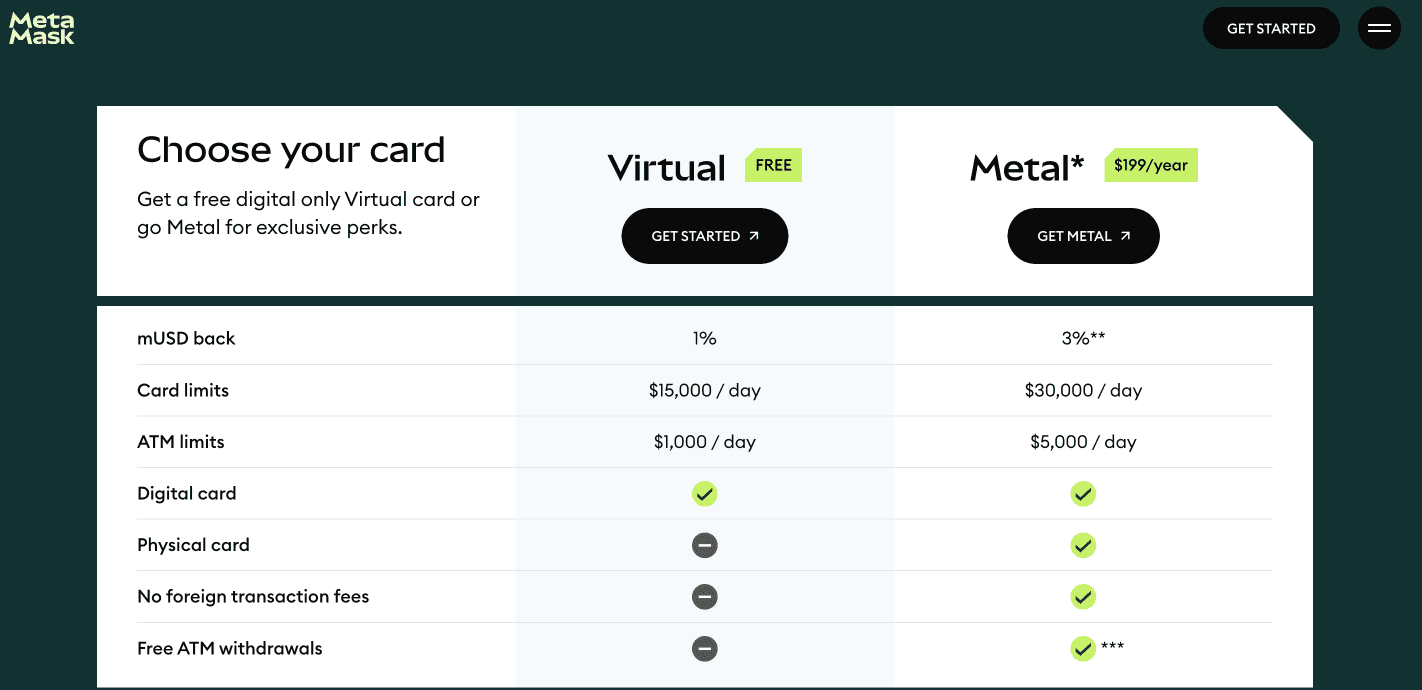
The free Virtual card currently earns:
1% mUSD back on eligible transactions.
The Metal tier costs $199 per year and earns:
3% mUSD back on the first $10,000 spent each year, then 1%.
A user spending $1,000 per month on the free Virtual card can therefore earn approximately $10 in mUSD, assuming eligible transactions.
Fees
The cost depends heavily on the asset and transaction.
MetaMask currently lists:
no annual fee for Virtual;
$199/year for Metal;
no token fee on certain locally denominated stablecoins;
0.5% in some cross-currency stablecoin cases;
0.875% on certain other crypto assets such as wETH;
1% cross-border fee on the free tier;
2% ATM fee on the free tier where ATM withdrawals are supported.
That means MetaMask is particularly compelling for stablecoin spending.
Availability
Current signup coverage spans a long list of countries across Europe and Latin America, as well as Canada and selected other jurisdictions.
The official page currently notes that US and UK Virtual Card sign-ups have been paused, despite earlier availability there, so readers should verify current eligibility rather than relying on older reviews.
Pros
Self-custody until payment
Free Virtual card
1% base mUSD rewards
USDT and USDC support
Apple Pay and Google Pay
Multiple blockchain networks
Mastercard acceptance globally after issuance
Cons
Token-specific fees
Metal costs $199/year
Availability is still changing
Supported spending assets are narrower than a large centralized exchange
Best choice for: MetaMask users and stablecoin holders who view custody as a core part of their card decision.
4. Wirex One — Best Crypto Card for Travel
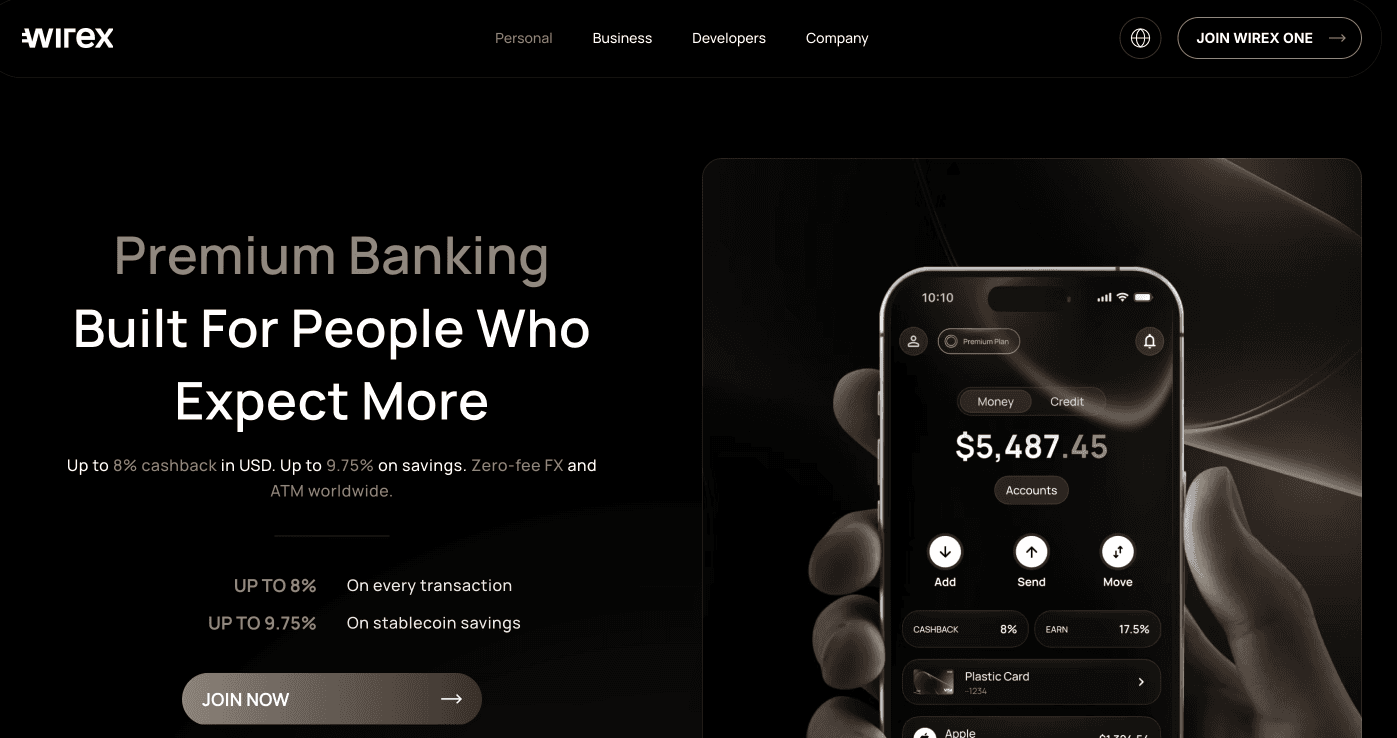
Best for: International and multi-currency spending
Rewards: 0.5% to 8% in USD
Wirex rebuilt its card proposition around Wirex One in 2026.
Its strongest selling point is international usability: the company currently markets zero FX fees, card usage across 150+ countries and cashback paid in USD rather than a native reward token.
Wirex Rewards
Cashback currently ranges from:
0.5% to 8%, depending on membership level.
Wirex’s membership tiers depend on both total portfolio size and the percentage held in WPAY.
The system currently has no subscription fee or mandatory token lock-up, but users still need WPAY exposure to unlock higher levels.
For $1,000 of eligible spending:
0.5% = $5
while the headline 8% rate would equal $80.
The latter should not be interpreted as an average-user reward.
Why Wirex Wins for Travel
Cashback is not the main reason.
The combination of:
zero-FX positioning;
global card acceptance;
ATM access;
USD-denominated cashback;
Apple Pay and Google Pay;
virtual and physical cards
makes Wirex particularly attractive for people who regularly spend across borders.
Pros
Up to 8% cashback
Base rewards from 0.5%
Cashback valued in USD
Zero-FX positioning
No membership subscription fee
No long-term WPAY lock-up
Apple Pay and Google Pay
Strong international focus
Cons
Maximum rewards require higher membership status
Membership depends partly on WPAY exposure
Product architecture changed significantly in 2026
Exact eligibility should be checked locally
Best choice for: International users who care as much about currency conversion as they do about cashback.
5. KAST — Best Crypto Card for Stablecoins & Global Spending
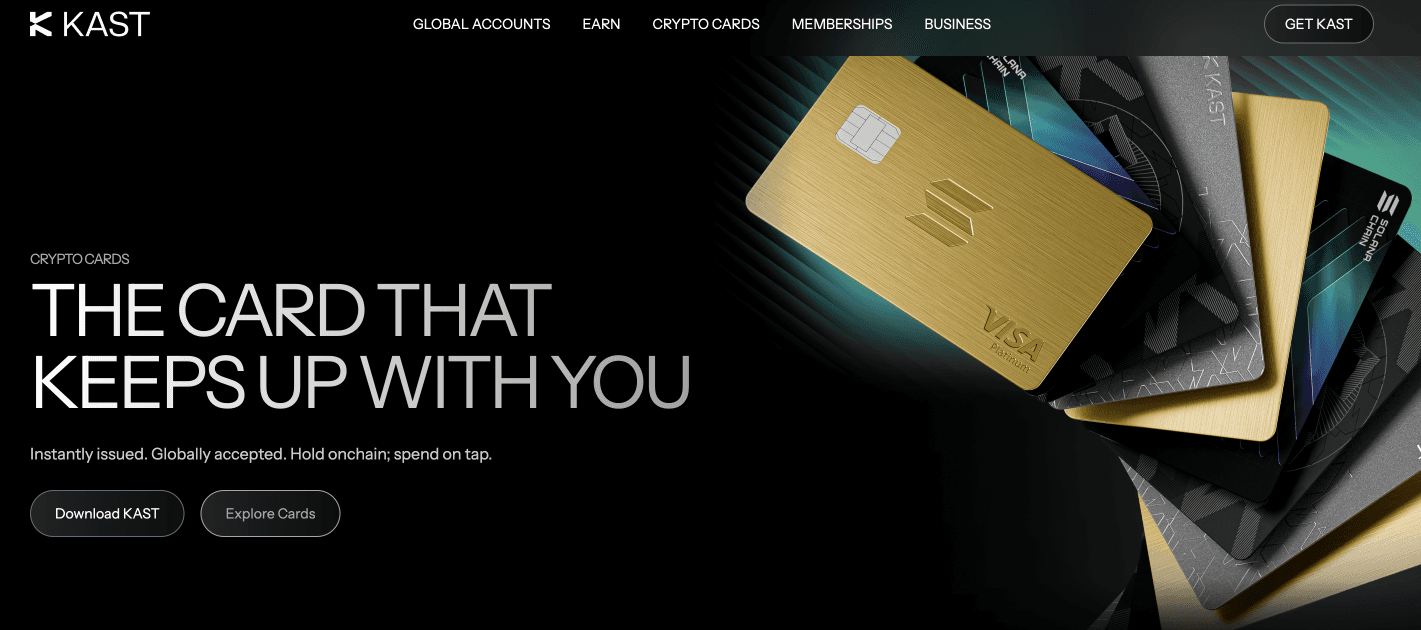
Best for: Stablecoin users, remote workers and global earners
KAST has become one of the most interesting companies in the crypto-card category because it is built around stablecoin banking and cross-border spending rather than an exchange account.
The company currently markets its platform across 170+ countries, with its cards accepted at approximately 150 million merchants, and supports stablecoin and crypto deposits alongside fiat payment functionality.
KAST Cashback
KAST’s current public website advertises:
up to 6% cashback on card spending.
We intentionally do not publish a single “base cashback” figure here because KAST’s product and membership structure has been changing quickly and the public terms do not currently provide the same stable, easily comparable tier table as providers such as Kraken.
That transparency gap prevents KAST from ranking even higher.
Stablecoin Advantage
KAST’s main value proposition is straightforward:
hold value in stablecoins or dollars, move money globally and use the associated Visa card for everyday spending.
This makes it especially relevant to:
freelancers paid internationally;
users who primarily hold USDC or USDT;
crypto users without access to strong USD banking products;
globally mobile professionals.
FX
Users should pay attention to FX costs.
KAST previously ran a temporary 0% FX promotion from April 1 through June 30, 2026, which means older marketing or reviews should not automatically be interpreted as the permanent fee structure.
Pros
Stablecoin-first proposition
Broad international positioning
Visa acceptance
USD account functionality
Up to 6% advertised cashback
Strong fit for remote workers and global earners
Cons
Custodial model
Reward tiers are less transparent publicly than some competitors
FX fees can apply
Product terms are evolving rapidly
Best choice for: Users who think of stablecoins as everyday money rather than primarily as trading assets.
6. Bybit Card — Best Crypto Card for Active Traders
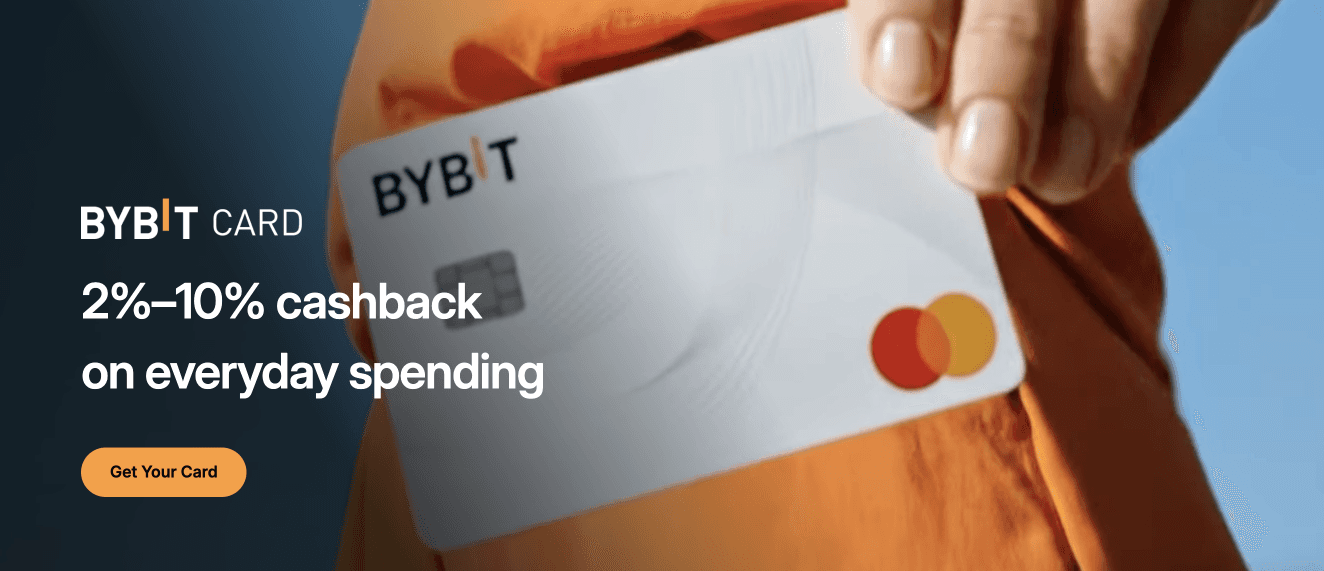
Best for: Users already active in the Bybit ecosystem
Type: Mastercard debit card
Rewards: 2% to 10%
Bybit Card offers one of the most aggressive reward ladders in the category.
Current rates range from 2% to 10%, with higher tiers unlocked through spending or account status.
Why “10% Cashback” Needs Context
The highest advertised rate is not a realistic base rate.
Bybit currently lists spending thresholds including:
2% starting rate;
4% at higher levels;
6%;
8%;
up to 10%.
Its published non-VIP structure requires progressively higher monthly spending, reaching approximately $25,000 for the top 10% tier in current documentation.
Reward point caps also apply.
So a user should not compare Bybit’s “10%” directly with a card offering an unconditional 1–3%.
Availability
Bybit currently lists card availability across EEA/Switzerland, AIFC, Australia, Brazil, Argentina, Mexico and selected APAC markets, with regional differences.
The card is available virtually and physically and supports mobile wallets in a number of markets.
Fees
There is no annual or dormancy fee under the current broad program description, although physical issuance, FX, ATM and crypto-conversion terms vary by region.
Pros
2% starting reward rate
Up to 10% at high tiers
Mastercard
Physical and virtual cards
Apple Pay / Google Pay in eligible markets
Deep integration with trading balances
Cons
Highest rewards require substantial activity
Reward caps apply
Regional fee structures differ
Custodial exchange model
Best choice for: Active Bybit traders who already qualify for stronger card tiers through their existing activity.
7. Nexo Card — Best for Spending Without Selling Crypto
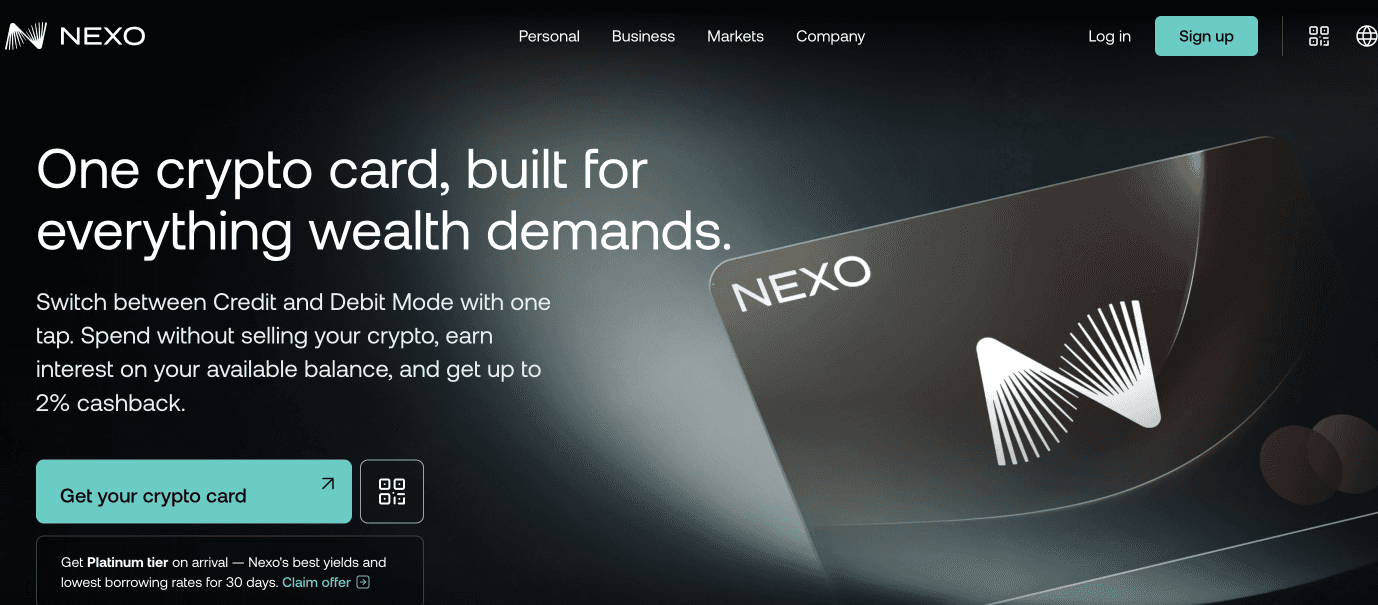
Best for: Long-term crypto holders who want access to liquidity
Type: Dual Debit / Credit Mode Mastercard
Rewards: Up to 2% in NEXO or 0.5% in BTC
Nexo’s biggest differentiator is the ability to switch between two spending modes.
Debit Mode spends supported crypto, stablecoins or FiatX balances.
Credit Mode allows cardholders to borrow against their crypto rather than selling it.
Nexo Cashback
Cashback applies to eligible Credit Mode purchases when the account meets Nexo’s requirements.
Current loyalty rates are:
Tier | NEXO Cashback | BTC Cashback |
|---|---|---|
Base | 0.5% | 0.1% |
Silver | 0.7% | 0.2% |
Gold | 1% | 0.3% |
Platinum | 2% | 0.5% |
Nexo states that cashback eligibility currently requires more than $5,000 in digital assets in the account.
So a Base user spending $1,000 in eligible Credit Mode transactions would earn roughly:
$5 in NEXO or $1 in BTC.
Fees and Eligibility
Nexo currently charges no monthly, annual or inactivity card fee.
Free ATM allowances range from €200/£180 at Base to €2,000/£1,800 at Platinum, followed by a 2% charge.
Foreign transaction charges currently begin at 0.2% on weekdays within EEA/UK/Switzerland and are higher elsewhere and on weekends.
The Nexo Card is currently targeted at eligible European and UK users.
Pros
Debit and crypto-backed Credit Mode
Ability to spend without automatically selling crypto
Up to 2% NEXO rewards
No card subscription fee
Apple Pay and Google Pay
Strong ATM allowance at higher tiers
Cons
Cashback requires Credit Mode
Account balance requirements apply
Best rewards require NEXO exposure
Borrowing creates interest and collateral risk
Primarily European availability
Best choice for: Crypto holders who value access to liquidity more than simple debit-card mechanics.
8. Crypto.com Prepaid Card — Best for Ecosystem Perks
Best for: Existing Crypto.com users
Type: Visa prepaid card
Rewards: 0% to 4.5% under the current Level Up structure
Crypto.com remains one of the most established names in crypto cards.
Its main weakness is that the strongest rewards require users to participate more deeply in the Crypto.com ecosystem.
Current Spending Rewards
Crypto.com’s current English documentation lists:
Basic: no spending rewards
Plus: 1.5%
Pro: 2.5%
Private $50,000: 3.5%
Private $500,000: 4.5%.
Reward caps apply to several tiers.
For example, the current Plus structure applies 1.5% to its eligible monthly spending band rather than providing unlimited cashback.
Extra Benefits
Depending on Level Up plan, Crypto.com offers benefits including subscription rebates and airport lounge access.
Those extras are a major part of the reason to use the card.
Watch the Fee Schedule
European users in particular should check the fee table carefully.
Crypto.com has already published changes taking effect October 1, 2026, including updates to certain foreign-transaction conditions and inactivity fees.
That illustrates why old Crypto.com card comparisons become outdated quickly.
Pros
Mature card ecosystem
Up to 4.5% current English-published spending reward
Visa acceptance
Subscription rebates
Lounge benefits on eligible tiers
Multiple card levels
Cons
Basic earns no card-spend reward
Higher rewards require subscriptions, CRO lockup/stake or large commitments
Reward caps apply
Complex regional/tier structure
CRO exposure affects real reward value
Best choice for: Existing Crypto.com users who already qualify for Level Up benefits.
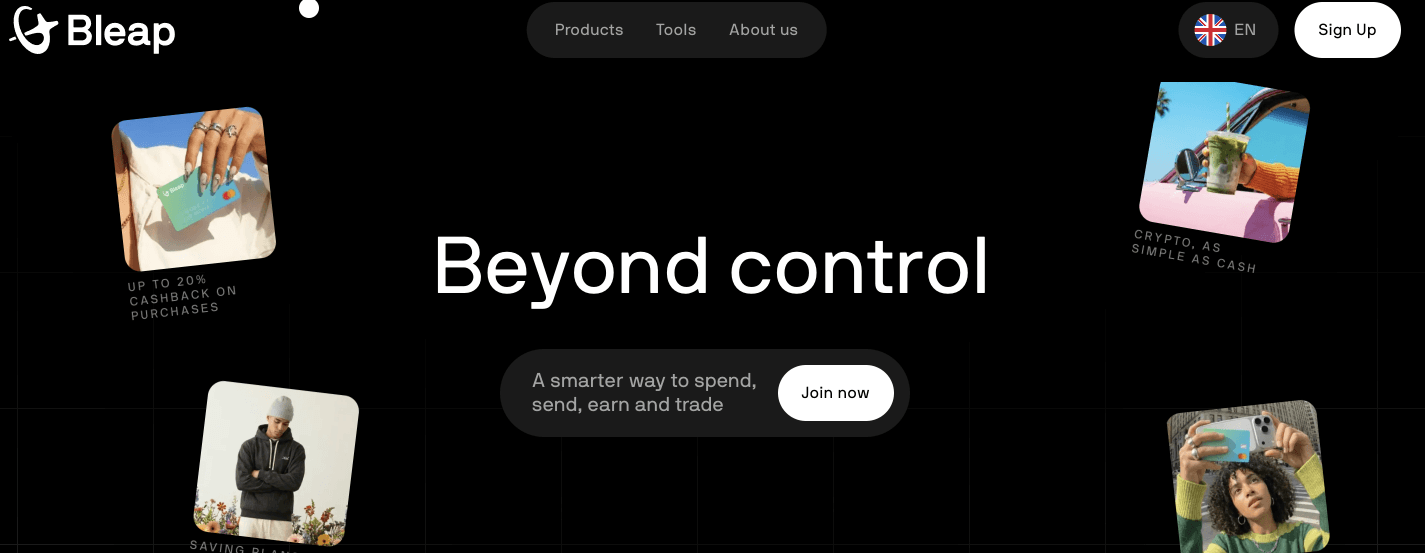
9. Bleap Card — Best Emerging Self-Custody Crypto Card for Europe
Best for: European users who want self-custody with straightforward cashback
Type: Self-custody-linked Mastercard debit card
Rewards: 1% base cashback, higher rates in selected categories
Availability: EEA and Switzerland
Bleap is a non-custodial fintech that lets users connect a wallet and spend through a Mastercard without first moving their everyday spending balance onto a centralized exchange. Bleap handles the fiat conversion when required, while funds remain in the user's connected wallet until they are spent.
Its standard cashback structure is also unusually easy to understand.
The current base rate is 1% on eligible purchases, with a monthly eligible-spend cap of €3,000. Selected categories receive higher rates, including 3% on Uber, Bolt and supported food-delivery services. Some subscription categories currently offer 20% cashback, including selected streaming, AI and gaming services, although individual merchant limits apply. Cashback is paid in USDC.
That means an ordinary €1,000 of eligible spending at the base rate would generate approximately:
€10 equivalent in USDC cashback.
The high category rates should not be interpreted as 20% cashback on all card spending.
Pros
Self-custodial model
1% straightforward base cashback
Rewards paid in USDC
Higher cashback for selected everyday categories
Mastercard
Strong European positioning
Cons
Limited to EEA and Switzerland
Highest cashback rates apply only to selected merchants/categories
Fair-usage caps apply
Newer product with a shorter track record than Kraken or Crypto.com
Best choice for: European users who want a self-custody-focused card with simple USDC rewards
10. Gnosis Pay — Best DeFi-Native Stablecoin Card
Best for: Self-custody-focused stablecoin users
Type: Self-custody-linked Visa card
Gnosis Pay remains one of the most technically interesting cards in the category.
Its Card Safe architecture gives users an onchain spending account and supports stablecoin-based card payments rather than requiring a conventional centralized-exchange balance.
Gnosis Pay is currently transitioning from its original direct-to-consumer card model toward partner-issued cards. Existing cards remain operational during the migration, while new card experiences are increasingly distributed through partner apps such as Rebind and MiniPay.
Fees
Gnosis Pay’s current published fee structure is one of its biggest strengths.
The provider currently states:
no transaction fee for normal card spending;
no Gnosis Pay-added FX fee;
Visa exchange rates for conversion;
free physical card order/shipping under current published terms;
five free ATM withdrawals per month or up to 200 in supported card stablecoin units, whichever comes first;
2% on additional ATM withdrawals after the allowance.
What Happened to 5% Gnosis Pay Cashback?
This is where many crypto card rankings are now outdated.
Gnosis Pay’s previous interim cashback programme offered up to:
4% base + 1% OG NFT bonus = 5%.
But the programme explicitly ended on June 30, 2026.
Gnosis Pay stated that partner-led incentives would follow.
For that reason, we do not include 5% as the card’s current permanent cashback rate in this ranking.
Availability
Gnosis Pay currently supports residents of selected European and Latin American markets, including countries such as Germany, France, the UK, Brazil, Argentina, Colombia and Mexico.
Pros
Self-custody-oriented architecture
No standard card transaction fee
No added Gnosis Pay FX fee
Strong stablecoin focus
Europe + selected LATAM availability
Transparent fee documentation
Cons
No fixed 5% cashback anymore
Narrower spending-asset model
Less intuitive for crypto beginners
Availability remains limited compared with global fintech products
Best choice for: DeFi-native users who care more about custody and spending architecture than rewards.
Real-World Crypto Card Rewards: What Can $1,000 of Spending Earn?
Headline cashback rates can create a distorted comparison.
The table below shows a more realistic picture.
Card | Approx. Reward on $1,000 Eligible Spend | Main Condition |
|---|---|---|
ether.fi Cash Core | ~$30 | Within first standard monthly spending band |
Kraken | $0–$20 | Depends on average balance |
MetaMask Virtual | ~$10 | 1% mUSD |
Wirex One | From ~$5 | Depends on membership tier |
KAST | Variable | Depends on current reward tier |
Bybit | Variable | Tier and reward limits apply |
Nexo Base | ~$5 NEXO / $1 BTC | Credit Mode + balance eligibility |
Crypto.com Basic | $0 | Higher plans needed for rewards |
Gnosis Pay | Program-dependent | Previous fixed cashback ended June 30, 2026 |
Bleap Card | | ~€10 equivalent in USDC | 1% base cashback on eligible spending |
This is why the biggest cashback percentage should never be your only criterion.
Best Crypto Cards by Use Case
Best Crypto Card for Europe: Kraken Card
For eligible EEA and UK residents, Kraken currently offers the strongest balance of cost, simplicity and asset flexibility.
More than 600 supported currencies, Mastercard acceptance and no Kraken transaction, ATM or card-level FX fees make it difficult to beat for ordinary spending.
Alternatives: Gnosis Pay for self-custody, Nexo for crypto-backed liquidity and ether.fi for stronger rewards.
Best Crypto Card for Cashback: ether.fi Cash
There are cards with higher advertised maximums.
But ether.fi’s 3% on the first Core monthly spending band is comparatively accessible and does not require the user to reach a $25,000 monthly spend just to unlock the headline rate.
For ordinary monthly spending, that makes it one of the strongest realistic cashback options.
Best Crypto Card for USDT and Stablecoins: KAST
KAST is built around stablecoin money movement rather than treating USDT or USDC as secondary assets inside a trading platform.
Its international focus and stablecoin-first architecture make it our preferred broad-market option for users primarily holding stablecoins.
Self-custody alternative: MetaMask Card.
DeFi-native alternative: Gnosis Pay.
Best Self-Custody Crypto Card: MetaMask Card
MetaMask provides one of the clearest self-custody propositions in the market.
Supported assets remain in the user’s MetaMask environment until payment rather than requiring the user to maintain their everyday spending balance on a centralized exchange.
Gnosis Pay is another strong option for users comfortable with an onchain stablecoin-focused account.
Best Crypto Card for Travel: Wirex One
Wirex One currently combines:
zero-FX positioning;
card use across 150+ countries;
ATM access;
Apple Pay and Google Pay;
cashback valued in USD.
For frequent international travelers, those factors can matter more than another percentage point of headline crypto cashback.
Best Crypto Card With Apple Pay and Google Pay
Most leading cards increasingly support mobile wallets, but availability still varies by jurisdiction.
MetaMask supports Apple Pay and Google Pay, as do Wirex and eligible Bybit card programs.
Always check your specific issuing country.
Best Crypto Card With Low Fees: Kraken Card
Kraken wins this category because its current published card structure eliminates several common card-level costs simultaneously.
No Kraken transaction fee, ATM fee or FX fee makes the economics easier to understand than most reward-heavy alternatives.
That does not eliminate the economic implications of converting or disposing of crypto itself.
Other Crypto Cards We Considered
Bitpanda Card
Bitpanda offers a simple flat 1% cashback on eligible crypto-funded purchases and supports Apple Pay and Google Pay.
We left it outside the Top 10 because every crypto-funded card payment triggers an asset-to-fiat trade subject to Bitpanda’s normal trading cost, and stablecoins are excluded from cashback.
It remains a reasonable choice for existing Bitpanda users in supported European markets.
How Crypto Cards Work
Crypto cards can look identical at a payment terminal while using completely different systems behind the scenes.
Crypto Debit and Prepaid Cards
These cards spend from an existing balance.
Crypto may be converted into fiat automatically when the payment happens, or the user may preload fiat or stablecoin value before spending.
Kraken, Bybit and Crypto.com fall broadly into this category.
Crypto-Backed Credit Cards
Crypto-backed products allow users to spend against collateral rather than necessarily selling the underlying assets.
Nexo Credit Mode is a clear example.
ether.fi also allows users to switch into Borrow Mode.
The advantage is maintaining crypto exposure.
The downside is that borrowing introduces interest and, depending on the structure, collateral and liquidation risk.
Self-Custody Crypto Cards
Products such as MetaMask Card attempt to let users retain control over their crypto until the payment occurs.
Gnosis Pay similarly uses an onchain Card Safe architecture.
This is fundamentally different from depositing assets onto a centralized exchange and spending from an exchange account.
Exchange-Linked Crypto Cards
Bybit, Crypto.com and Kraken connect card spending with centralized platform balances.
This can provide:
broader asset selection;
simple conversion;
integrated rewards;
easy card management.
But it also introduces custodial exposure to the platform.
How to Choose the Best Crypto Card
1. Check Whether the Card Is Available in Your Country
This should come before cashback.
A card can be accepted at millions of merchants worldwide while still allowing residents of only a limited number of countries to apply.
Issuance availability and merchant acceptance are different things.
2. Calculate Real Cost
Use:
Real card value = rewards − subscription − FX − crypto conversion − other card fees
A card offering 3% rewards with expensive conversion may be less attractive than a 1% card with minimal spending costs.
3. Ignore “Up To” Until You Read the Conditions
Ask:
What do I earn at the entry level?
Then check what is required to unlock the maximum.
It may involve:
$50,000 of assets;
$25,000 of monthly spending;
a native token;
a paid subscription;
a premium membership.
4. Check the Reward Cap
A 2% rate capped at $5 per month is not economically equivalent to uncapped 2%.
Caps matter just as much as percentages.
5. Decide Whether You Want Self-Custody
If retaining direct control over crypto is important, MetaMask or Gnosis Pay may make more sense than an exchange card.
If you already keep funds on Kraken, Bybit or Crypto.com, a centralized card may be simpler.
6. Look at the Assets You Actually Spend
A card supporting 600 cryptocurrencies is not automatically better for someone who spends only USDT.
Stablecoin-focused users should pay particular attention to:
USDT/USDC support;
conversion fees;
supported networks;
stablecoin cashback eligibility.
7. Consider Travel and Mobile Wallet Support
For daily use, these features can matter more than rewards:
Apple Pay;
Google Pay;
ATM access;
physical cards;
FX costs;
international merchant acceptance.
Crypto Card vs Crypto Wallet: What’s the Difference?
A crypto wallet is primarily a tool for holding, sending or interacting with digital assets.
A crypto card connects those assets — or value backed by those assets — to traditional payment rails such as Visa, Mastercard or American Express.
The two can overlap.
MetaMask Card, for example, connects a self-custodial crypto wallet directly with Mastercard spending.
But a card is not a replacement for a wallet if your main goal is long-term asset custody.
For that use case, see our comparison of the best crypto wallets.
Frequently Asked Questions About Crypto Cards
What is the best crypto card in 2026?
We rank ether.fi Cash as the best overall crypto card in 2026 because it combines strong realistic rewards, wide geographic availability, Direct Pay, crypto-backed borrowing and a non-custodial account architecture.
Kraken is our preferred low-fee option, while MetaMask is our top self-custody choice.
What is the best crypto card for Europe?
For most eligible UK and EEA users, Kraken Card has one of the strongest overall propositions because of its transparent low-fee structure and support for more than 600 crypto and cash currencies.
Gnosis Pay is better suited to users prioritizing self-custody.
Which crypto card has the highest cashback?
Bybit advertises rates up to 10%, while Wirex advertises up to 8% and KAST up to 6%.
However, maximum rates typically come with qualification requirements.
For ordinary monthly spending, ether.fi Cash’s 3% Core initial spending band is one of the stronger realistically accessible offers we found.
What is the best crypto card for USDT?
For broad stablecoin-oriented use, KAST is our preferred option.
For users who want self-custody, MetaMask Card supports USDT and USDC alongside other selected assets.
Can I use a crypto card with Apple Pay?
Yes.
Many leading crypto cards now support Apple Pay or Google Pay, including MetaMask, Wirex, Nexo and eligible Bybit programs.
Support can still vary by region.
Are crypto cards Visa or Mastercard?
Both.
Examples in this ranking include:
Visa: ether.fi Cash, Crypto.com, Gnosis Pay, KAST.
Mastercard: Kraken, MetaMask, Nexo, Bybit, Bleap.
Are all crypto cards debit cards?
No.
The category now includes:
debit cards;
prepaid cards;
credit cards;
crypto-backed credit;
hybrid spending products.
That is why this ranking targets the broader search term crypto cards, while also covering best crypto debit cards as a secondary search intent.
Do crypto cards require KYC?
Mainstream crypto cards generally require identity verification because regulated payment providers and card issuers sit between blockchain assets and traditional payment networks.
Exact requirements vary by provider and jurisdiction.
Final Verdict: What Is the Best Crypto Card in 2026?
The best crypto card depends on what you actually want the card to do.
For the strongest combination of rewards, availability and crypto-native functionality, our overall winner is ether.fi Cash.
For low-fee everyday spending, choose Kraken Card if you are eligible.
For self-custody, MetaMask Card is our preferred option.
For international travel, Wirex One has one of the strongest cross-border propositions.
For stablecoin-first spending, KAST is particularly interesting.
And if you want to spend without necessarily selling your crypto holdings, Nexo’s Credit Mode provides a fundamentally different option.
The most important lesson from comparing these products is simple:
Do not choose a crypto card because its homepage shows the largest cashback percentage.
Instead ask:
What will I realistically earn?
What will I actually pay?
Can I get the card in my country?
Where are my assets held before I spend them?
Those questions usually reveal a very different winner than the headline cashback rate.
Research & Updates
ChainLeads verifies card fees, rewards, availability and eligibility against official provider documentation and checks whether older reward programs are still active before including them in comparisons.
Research last updated: September 21, 2026.
Crypto card products change frequently. Always verify the latest provider terms before applying.